Faucet & Sink Repair
Cure drips, weak flow, stuck stop valves and puddles in the cabinet below.
A disposal that hums but will not spin, leaks into the cabinet or smells bad can usually be fixed or replaced in a short visit. A disposal leaking into the cabinet should be switched off at the wall and reported to the 24/7 line.
Call, describe the noise or the leak, and a contractor is lined up.
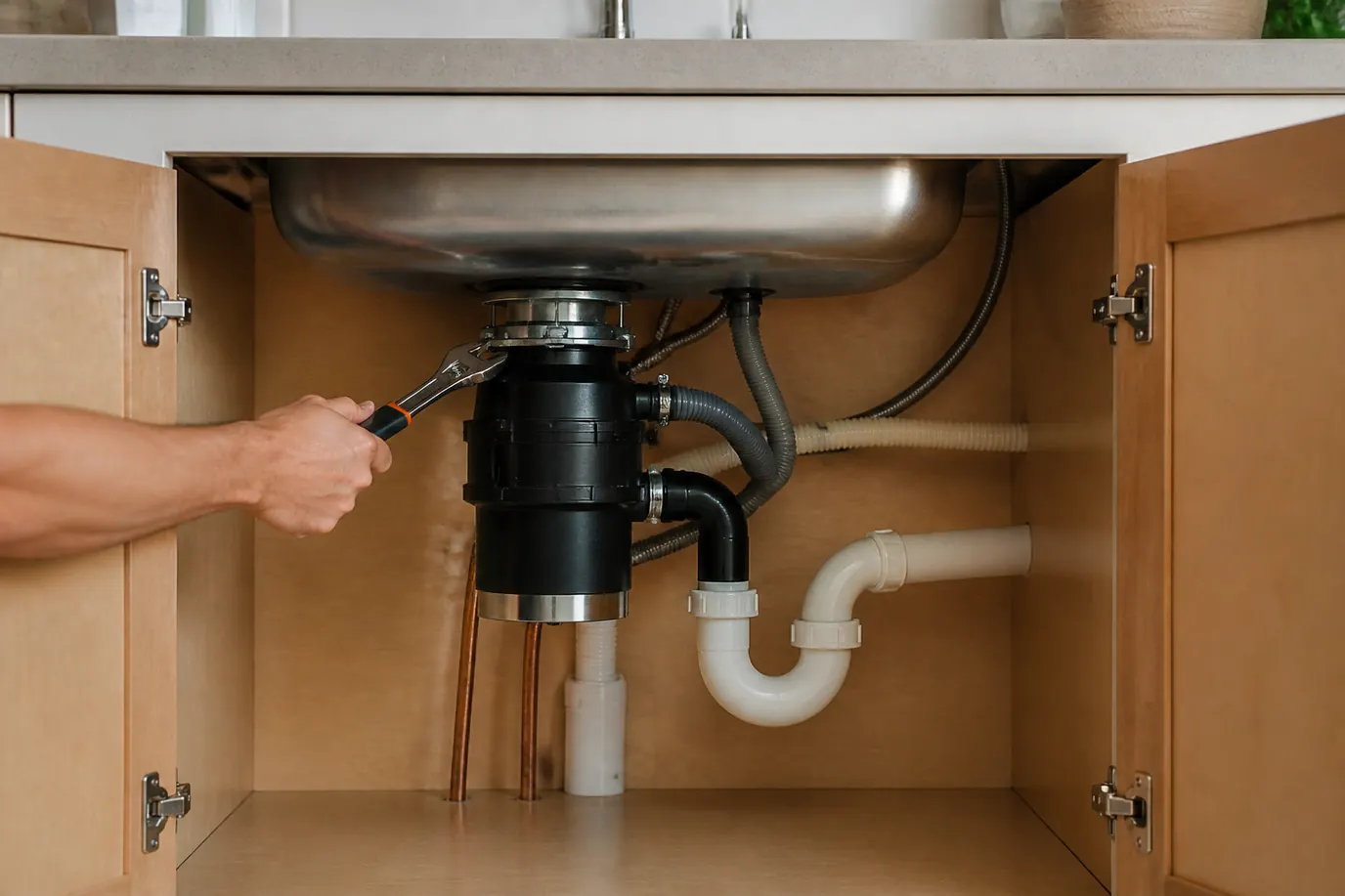
Turn the disposal off at the switch and unplug it or switch off its breaker before reaching in. Never put your hand in the opening. Use tongs or pliers to remove an object.
Many units have a hex socket on the bottom to turn the blades by hand with an Allen wrench, and a red reset button that pops when the motor overheats.
A leak at the top is usually the flange seal. A leak at the side may be a drain connection or the dishwasher inlet. A crack in the housing means replacement.
Dry the cabinet and run water to see where moisture starts. That tells the contractor what to bring.
Scale builds up on the grinding chamber and slows the motor. Drain lines in older kitchens also narrow with grease and scale.
If the disposal smells, ice and citrus peel help a little, but a clogged trap is a more common cause.
Repair is usually cheaper than a new unit, and several things shift the quote.
Ask which brand and horsepower the quote includes.
A new disposal bolts to the sink flange, connects to the drain and the dishwasher inlet, and plugs into an outlet or is wired in. Horsepower, feed type and noise insulation vary by model.
Ask whether the quote covers a new power cord, a new flange and disposal of the old unit.
Grease, coffee grounds in volume, fibrous peels, bones and pasta can clog the drain. Run cold water during and after use.
If the sink still backs up with the disposal off, the clog is in the drain. See drain cleaning.
A humming unit with no spin is usually jammed. A unit that does nothing may have tripped its reset. A leak from the bottom points to a cracked housing, and a leak from the top points to a loose flange or sink seal.
Keep hands out of the unit. Turn off power before looking.
Horsepower, sound insulation and feed type vary. A larger motor handles more, but the drain and the cabinet must also suit it. Ask about the dishwasher connection and whether the electrical hookup needs a new outlet or switch.
A disposal is not a trash can. Clearing the plate before rinsing extends its life.
Cure drips, weak flow, stuck stop valves and puddles in the cabinet below.
Open clogged sinks, tubs, laundry lines and main drains, and find out why they keep stopping.
Pinpoint concealed water loss in walls, floors or buried pipe using listening gear and pressure tests.
Switch it off and unplug it, then turn the blades with an Allen wrench from the bottom. Press the red reset button before running it again.
A leak at the flange or a connection can be repaired. A cracked housing means replacement.
Food residue and grease coat the chamber and the drain. A cleaning and a clear drain usually solve it.
It is a short job for a plumber, usually under an hour or two, if the connections are sound.
Switch it off, empty the cabinet and place a bucket under the leak. Call the 24/7 line. A leak at a seal or flange can often be repaired, while a cracked housing means replacement.
Grease, fibrous peels, bones and stringy foods can jam or clog drains.
Switch it off, then call the line. A dispatcher will match you with a contractor.
Service area centered on Goodyear and nearby Maricopa County cities.